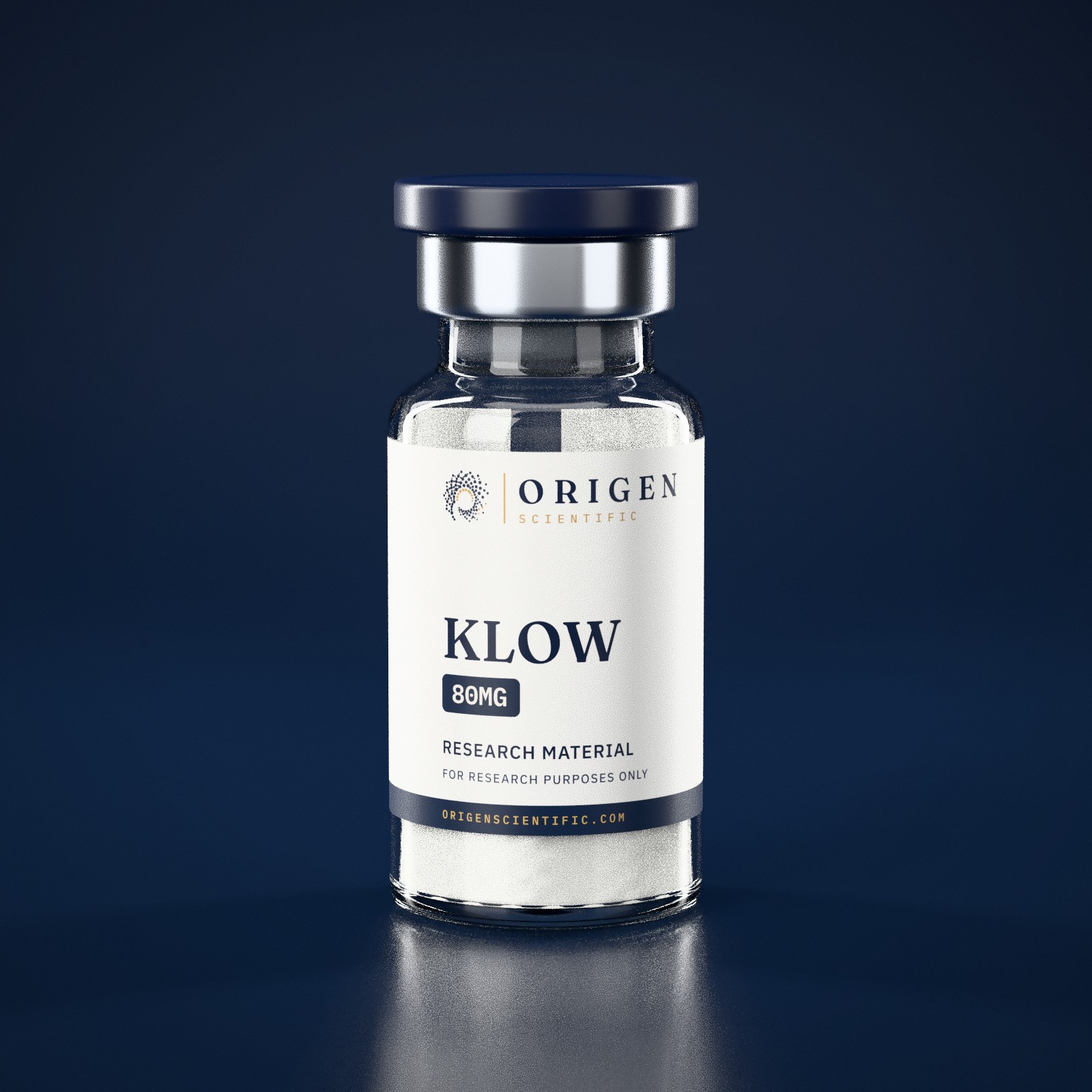
● In stockView COA ↗
TB-500/ BPC-157/ KPV/ GHK-CU (KLOW)
Cat. No. KLOW | 80 mg per vial | Blend
$109.99per vial
Bundle & save
$109.99 / vial at this quantity
Orders submitted before 2 PM ET dispatch the same business day after approval and payment confirmation. U.S. shipping is $15 per order, free on orders of $250 or more.
- Lab testedISO/IEC 17025 lab
- Made in the USALyophilized in the U.S.
- Same business dayFree U.S. shipping at $250
Quantity savings are applied automatically. Retail orders allow up to 10 vials per product.
Lab results
ISO/IEC 17025-accredited lab- Endotoxin threshold
- ✓ Pass
- Microbial analysis (PCR)
- ✓ Pass
- Purity
- >99%Premium grade
Applies to our peptide products. Request your batch-specific report →
Product details
KLOW combines GHK-Cu, BPC-157, TB-500, and KPV in a single research preparation. Component quantities are listed below where available.
Research use only. Not for human or animal use.
Specifications
| Form | Lyophilized powder |
|---|---|
| Total Compound Content | 80 mg per vial |
BLEND Composition
Component amounts per vial.
BPC-157
10 mg / vialTB-500
10 mg / vialKPV
10 mg / vialScientific references Optional background reading
| Synonyms | KLOW |
|---|
A mixture does not have one molecular structure or one molar mass. The viewer identifies individual reference components, and the literature cards describe research on those components separately.
Mechanism under investigation
Research on GHK-Cu, BPC-157, TB-500, and KPV examines different molecular and cellular systems. No combined mechanism or interaction is established by placing these compounds in one vial. The selected references are component-level context, not studies of this blend.
Selected literature
Cell culture
Copper-peptide interactions in fibroblast cultures
The investigators measured collagen synthesis in fibroblast cultures exposed to GHK-Cu. This component-level experiment does not establish properties of a multi-compound blend.
Maquart FX et al. · FEBS Lett · 1988 · PMID 3169264Rat-derived cell culture
Growth-hormone receptor expression in tendon cells
Cultured rat tendon fibroblasts were used to examine receptor expression and downstream signaling following BPC-157 exposure. These results describe the experimental cells, not this supplied material.
Chang CH et al. · Molecules · 2014 · PMID 25415472Analytical chemistry
Analytical identification of the TB-500 fragment
Mass spectrometry identified an acetylated thymosin-beta-4 fragment in a TB-500 preparation. The work illustrates why the fragment identity must be distinguished from full-length thymosin beta-4.
Esposito S et al. · Drug Test Anal · 2012 · PMID 22962027Cell culture · mouse models
KPV transport and inflammatory signaling
The authors investigated PepT1-dependent KPV uptake and signaling measurements in intestinal and immune-cell systems, with additional mouse experiments. The paper concerns KPV alone.
Dalmasso G et al. · Gastroenterology · 2008 · PMID 18061177These publications describe their own experimental materials and models, not testing of this product. Research-use policy →
Also in the catalog